Organizations have workloads everywhere, which all support and interact with each other. This requires “everywhere capabilities”—that is, hybrid and multi-cloud visibility and manageability.


Gone are the days when you bought a piece of self-contained software for your application that you had to install and maintain (and upgrade) on servers that you owned and operated. We’ve come a long, long way. First, we deconstructed those monoliths, separating the functional code from the resources and processes that support them. This modularity improved code reuse and integration, driving more agile innovation and shifted management from standalone applications to workloads. Second, the cloud provided an alternative to owning the hosting infrastructure, opening up the options for where workloads can live.
Where are all of these workloads today? Turns out, they’re everywhere, as our recent Multi-Cloud Management Survey found. We surveyed 360 cloud decision-makers to break down the percentage of their workloads running on-premises, in a private cloud, and in the big three public clouds. As you can see, workloads are, on average, fairly well split across the different environments.
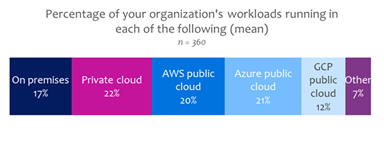
This tells us two things. First, organizations are managing hybrid cloud environments—that is, they have workloads running in the public cloud, in a private cloud, and on-premises. Second, when it comes to the public cloud, enterprises are using more than one cloud service provider (CSP). Let’s dive a little deeper into each of these.
See also: Survey: Cloud is Platform of Choice for Analytics Databases
Businesses are continuing to move more of their workloads into the public cloud. In fact, the number of organizations with more than half of their workloads in the public cloud grew 75% over the past year. This is not to say that on-premises deployment is headed for extinction. On the contrary—only 25% said that their strategy for future cloud migrations is primarily public cloud and even fewer stated they would migrate all of their workloads to a public cloud. This makes sense because there are many reasons to keep certain workloads on-premises. Because the cloud is a newer environment, it’s easy to focus exclusively there when planning and implementing tools and processes to enable visibility and management. After all, workloads that remain on-premises have been on-premises for years or even decades, so nothing needs to change there, right? Well, no. The chances are high that those workloads support and interact with workloads that are running in the cloud, changing the nature of what you need to be able to see and manage. If you simply layer cloud-specific capabilities on top of on-premises-specific ones, you’ve created a siloed system for an integrated environment. This is why, if you have a hybrid cloud environment, you need to purposefully adopt hybrid cloud tools and strategies.
See also: The Cloud Journey: Implementing a Hybrid IT Infrastructure
On the multi-cloud front, 82% of survey respondents have workloads deployed in more than one public cloud, and 78% are using more than three public clouds. Furthermore, 51% plan to increase the number of public clouds by the end of this year, and many organizations are planning to jump into the multi-cloud waters this year, as well. Of those not currently using more than one cloud, 38% will be using three or more by the end of 2022. Similar to hybrid cloud, this has implications for overall visibility and ongoing management. Most Cloud Solution Providers (CSP) offer native tools, many of which are free. It’s tempting to use these tools, as they’re already built right in. But a CSP-specific tool, by definition, can only be used for that particular CSP. If you’re using these native tools, you can’t get a global picture of workloads across the entire ecosystem—or you’re having to spend a lot of time stitching together disparate data and managing separate workflows. Therefore, if you have a multi-cloud environment, you need to purposefully adopt tools and strategies that span multiple CSPs.
If we were still running standalone applications, it would probably be perfectly fine to treat each environment—on-premises, private cloud, and each CSP-specific public cloud—as its own individual infrastructure. But that’s not the world we live in. Organizations have workloads everywhere, which all support and interact with each other. This requires “everywhere capabilities”—that is, hybrid and multi-cloud visibility and manageability. With your workloads everywhere, finding the right support and capabilities to optimize your cloud strategy will be important as the industry continues its digital transformation shift.
Jonathan (Jon) Cyr is responsible for Product Management at Virtana. In this role, Jon owns overall strategy and product direction of the Virtana portfolio of “ITOM” products. In addition, Jon drives Product Tech Marketing. Jon brings twenty-plus years’ experience in architecting enterprise solutions for the IT Operations Management (ITOM) market. Recently, his focus has been on hybrid cloud and Platform-as-a-Service (PaaS) services, primarily at Dell EMC and John Hancock. Prior to Dell EMC, he spent 14 years at Hewlett-Packard Enterprise in product line management and customer success delivering solutions for the ITOM Software market.
Cloud Data Insights is a blog that provides insights into the latest trends and developments in the cloud data space. We cover topics related to cloud data management, data analytics, data engineering, and data science.
Property of TechnologyAdvice. © 2026 TechnologyAdvice. All Rights Reserved
Advertiser Disclosure: Some of the products that appear on this site are from companies from which TechnologyAdvice receives compensation. This compensation may impact how and where products appear on this site including, for example, the order in which they appear. TechnologyAdvice does not include all companies or all types of products available in the marketplace.