With stream processing flipping the data processing paradigm from store then process to process then store, the critical capabilities to evaluate when building streaming applications are vastly different from those for batch. Here we discuss the available choices for building streaming solutions and a high-level guidance for selecting them.



Structured and unstructured streaming data are ubiquitous – we just don’t realize it. From data continuously streaming from phones to sensors gathering and streaming data, CCTVs everywhere, streaming data is zooming by all the time. Streaming technologies are being leveraged by organizations across different verticals, like supply chain, eCommerce, cybersecurity, and many more, to harness this flowing data and derive the right insights at the right time and place.
Streaming is a rapidly growing space with multiple solutions and vendors with overlapping capabilities. The landscape can be confusing with terms like “streaming platforms,” “stream processing,” “streaming databases,” and “streaming libraries.” The different solutions are briefly discussed below.
See also: 12 Streaming Analytics Solutions to Consider in 2024
Some of the defining characteristics of streaming data include immutability, arriving out of order and with an unpredictable pattern, and non-determinism. This makes working with streaming systems challenging. Because of the changed paradigm in streaming, where data flows continuously and queries are static, it requires architects and developers to comprehend new concepts, like watermarking, windowing, back-pressure handling, delivery semantics and guarantees, state management, and the ability to keep up with unpredictable workloads and patterns to handle duplicate and missing data. Understanding, developing, testing, and operationalizing streaming systems has a steep learning and adoption curve.
Streaming systems need to be resilient to failures across data tiers, systems, hardware, and software to ensure graceful recoverability, consistency, and correctness across different failure scenarios. Streaming data is unrecoverable unless buffered within a given retention time. Hence, streaming platforms need to address single points of failure and incorporate capabilities like checkpointing to recover from failures.
Testing streaming solutions poses challenges in simulating scenarios spanning general and edge cases within and across data centers. Operationalizing streaming solutions and setting up fault-tolerant environments present additional challenges from the right sizing and tuning for optimal performance across diverse workloads.
Figure 1 shows a mind map of major characteristics across the different categories of streaming systems.
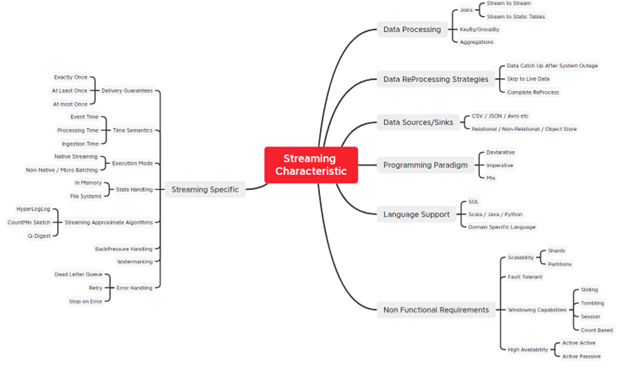
Due to the inherent complexities in streaming systems, it is important for enterprises to keep things simple and not over-engineered and select the right tools, frameworks, and platforms that abstract away the associated complexities. Note that not all streaming solutions support characteristics, as shown in Figure 1.
Streaming solutions are not a good fit for hard real time use cases when there is a need for single-digit milli-second end-to-end latency. Streaming solutions are also not a good fit where accuracy is critical, like accounting use cases. Before embarking on building streaming solutions, organizations must have a clear understanding of the technologies available, their strengths, and limitations and correlate them with functional use cases and requirements.
Streaming components do not exist in isolation, more so in today’s disaggregated data ecosystem. It is wise to choose solutions that integrate with other tools and frameworks in the ecosystem. Organizations must know where a streaming solution is going to be useful – in data integration, stream processing, or streaming analytics – and, based on that, decide what kind of solution is most appropriate.
As enterprises see a growth in the adoption of streaming across a range of use cases, criteria like disaster recovery – RTO (Recovery time objective), cross-data center and multi-cluster access, and data sovereignty need to be carefully evaluated and assessed. It is important to outline non-functional requirements (NFRs) like uptime SLAs, desired ingestion throughput, concurrency, end-to-end latency in percentiles, disaster recovery strategy, enterprise support, and SLAs around cloud services across all the use cases.
Streaming platforms are complex, with lots of interdependent tuning and performance knobs, which require a deep understanding of distributed systems architecture. Organizations are advised to perform performance benchmarks with their workloads and correlate them with vendor and publicly available benchmark results. Stream processing engines like Spark and Flink should not co-exist on the same cluster as the streaming platform, and this increases end-to-end latency due to network overheads.
Other questions architects and engineers should ask include:
Streaming skills are difficult to find, and streaming developers are some of the highest paid in the industry. Enterprises need to take stock of what kind of skill sets are available in-house and how they can be up-skilled or bring in external help with streaming development, testing, and deployment. Technical POCs and NFR (non-functional) capabilities are critical aspects to be assessed along with licensing, TCO, and customer and community support before choosing a solution.
See also: Real-time OLAP Databases and Streaming Databases: A Comparison
The streaming landscape is littered with failed technologies. It is therefore imperative for organizations to carefully evaluate and select streaming solutions. Over the last few years, streaming solutions have matured to enable rapid development and deployment, which minimizes the learning curve and abstracts out deeper technical details required to build and operationalize. These tools, though, considerably reduce the configurability and flexibility, and organizations need to weigh the pros and cons before selecting a solution.
Sumit Pal is an Ex Gartner-VP Analyst in Data Management & Analytics where he advised CTOs, CDOs, CDAOs, Enterprise Architects and Data Architects on Data Strategy, Data Architectures, implementation and choosing tools, frameworks, and vendors for building data platforms and end-to-end data driven systems. Sumit has advised hundreds of organizations and CDOs over the last 5 years and provided guidance, insights, trend analysis on best practices with technology to solve their complex data challenges. Sumit spans the spectrum - from formulating data strategy with CDO/CTO teams to architecting, designing, and building data platforms and solutions to writing, deploying, and debugging code. Sumit is a published author of a book on SQL Engine and has also developed a MOOC course on Big Data. Sumit has also published a MOOC - Big Data Analyst. Sumit hiked to Mt. Everest Base Camp in Oct 2016. Sumit also blogs at https://sumitpal.wordpress.com/.
Cloud Data Insights is a blog that provides insights into the latest trends and developments in the cloud data space. We cover topics related to cloud data management, data analytics, data engineering, and data science.
Property of TechnologyAdvice. © 2026 TechnologyAdvice. All Rights Reserved
Advertiser Disclosure: Some of the products that appear on this site are from companies from which TechnologyAdvice receives compensation. This compensation may impact how and where products appear on this site including, for example, the order in which they appear. TechnologyAdvice does not include all companies or all types of products available in the marketplace.